
“Blauer Enzian” (Blue Gentian) “F-Zug” Car Set
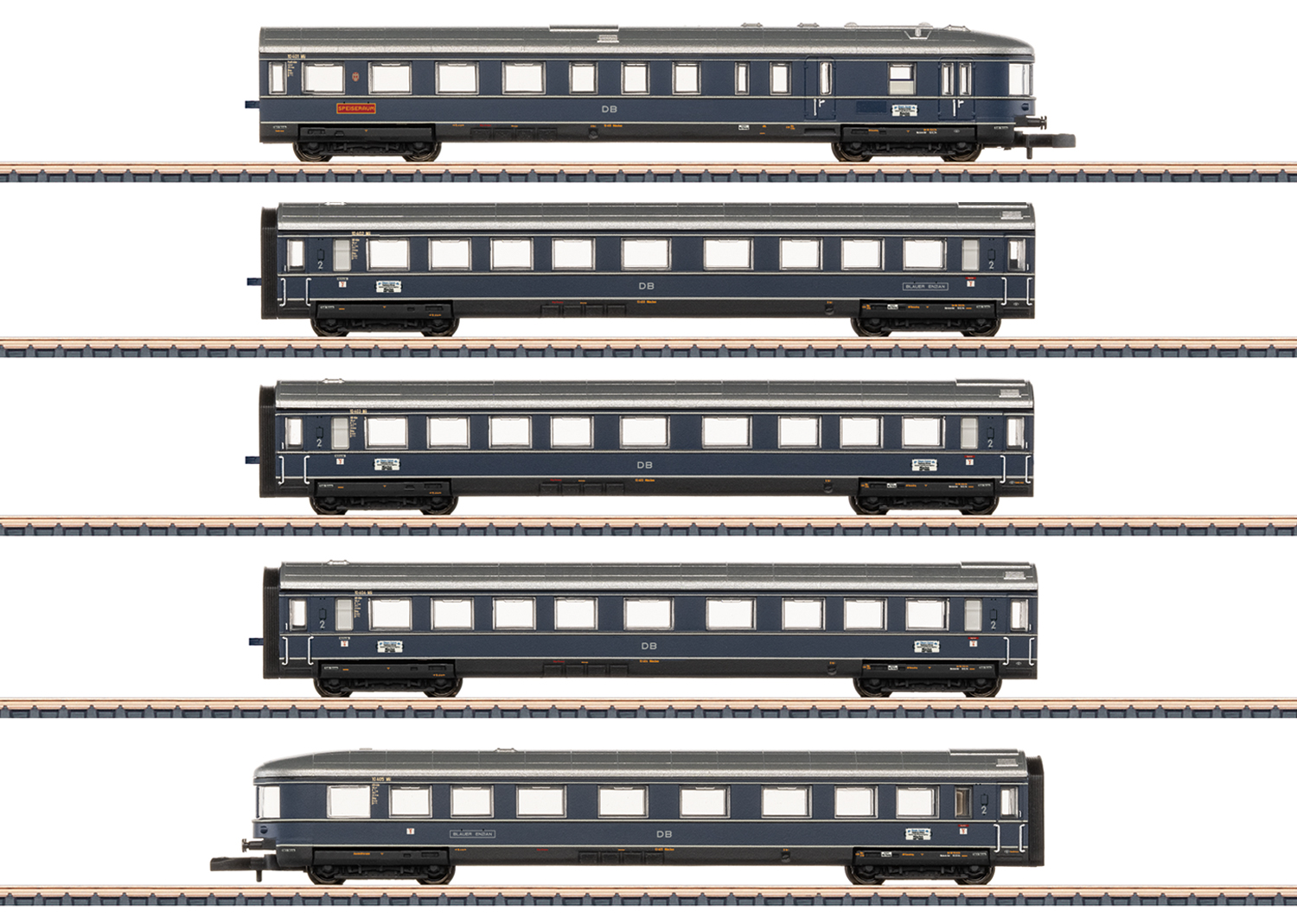
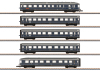
Prototype: Five German Federal Railroad (DB) express train passenger cars of different types. One end car with a baggage compartment, machine room, kitchen, and dining area, three intermediate cars 1st/2nd class, and one end car, 1st/2nd class, with an observation lounge. Train route: Hamburg - Munich. The cars look as they did in era III.
Most Important Facts
| Article No. | 87615 |
|---|---|
| Gauge / Design type | Z / 1:220 |
| Era | III |
| Kind | Passenger Car Sets |
Check with your local dealer Find Dealer
Highlights
- Red marker lights.
-
Product description
Model: Red marker lights using maintenance-free red LEDs on the rear end car change over with the direction of travel. The set is fitted with close couplers between the cars and with system couplers at the loco end and the rear end.
The cars have finely-detailed paintwork and lettering. Total length over the buffers approximately 510 mm / 20-1/16".
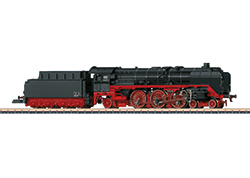
The matching traction loco for the set is item 88015.
Find more Märklin explanation videos on our YouTube Channel
Spare parts for our articles can be found here in our spare parts search.
-
Publications
- New items brochure 2026
-
Prototype information
“F-Zug” “Blauer Enzian” (Blue Gentian) The “Blauer Enzian” (Blue Gentian) stood for the legendary years of Germany’s economic miracle. Not long after the foundation of the German Federal Railroad (DB), the first signs of the economic miracle in West Germany appeared. Those in charge at the DB quickly recognized that business managers would need a reliable transport network. As early as 1951, after the worst of the damage inflicted by the Second World War had been repaired, they prepared a network of high-speed trains that would connect the key metropolitan centers of West Germany. Although the “F-Zug” network could trace its roots back to the pre-war network of express rail cars, it had one important difference: Whereas the German State Railroad Company (DRG) had made Berlin the focus of its network of “Fliegende Züge” (Flying Trains) before the Second World War, the main routes of the “F-Zug” network ran from north to south due to the Iron Curtain. High-speed train connections were established between Hamburg, Bremen, the Rhine-Ruhr region, and Cologne, Frankfurt (Main), Stuttgart, Nuremberg, Munich, and Basel. These trains departed in the morning and returned in the evening, with limited stops in between. The objective was to make it possible to conduct an external business meeting in a single day. Naturally, this didn’t work over longer distances, such as from Hamburg to Munich. In keeping with the “FD” abbreviation used before the war, these new train types were now called “F-Züge,” where “F” stood for “Fern” or “Long Distance”. For these journeys, an “F” supplement was payable in addition to the regular fare. Starting in 1953, the train routes were given impressive names: The first was the F 55/56 train pair (Hamburg – Munich – Hamburg), which was given the name “Blauer Enzian” (Blue Gentian). With “Gambrinus,“ “Helvetia,“ “Senator,” “Roland,” and “Domspatz” – to mention just a few – the “F-Zug” trains bore other illustrious names and became the pride of the newly established German Federal Railroad. Now, the “Blauer Enzian” (Blue Gentian) name had nothing to do with the well-known song by a renowned German folk singer – that only came much later. On the contrary, the name was the result of a competition organized for passengers, the majority of whom voted for the Alpine flower. It is possible that passengers associated the paint scheme and destination close to the Alps with the flower’s pure and vibrant blue color that is rarely seen in the plant kingdom. The “Blauer Enzian” (Blue Gentian) enjoyed extra-special status among the “F-Zug” trains when its rolling stock was upgraded in December 1953 with the car set from the former Henschel-Wegmann train, which ran between Berlin and Dresden from the start of the 1936 summer timetable until the outbreak of the Second World War. It operated the route of almost 180 kilometers / 112 miles using two pairs of trains per day. The fastest service covered this distance in one hour and 35 minutes, making the Henschel-Wegmann train around half an hour faster than all previous trains. Even today, the service is nowhere near comparable, with the fastest connection between Berlin and Dresden taking around two hours and 15 minutes. In 1946, the train of cars sat, looted and no longer operational, in Hamburg-Langenfelde. In 1952, the DB sent it back to the original manufacturer, Wegmann, in Kassel, where the five cars were fully refurbished, modernized, and painted in the blue of the “F-Zug” trains. The actual design of the cars remained largely unchanged. However, the trucks were fitted with a fourth suspension system, and the interior layout and fittings were adapted to meet the new requirements of the “F-Zug” services. With its steel-blue and silver paint scheme and black skirting, the train was certainly an elegant sight. After unveiling the refurbished train to the public at the German Communications and Transport Exhibition in Munich from June to November 1953, the DB operated it for five years, beginning in December 1953, as the long-distance express train F 55/56 “Blauer Enzian” (Blue Gentian) between Hamburg and Munich and calling at Hanover, Göttingen, Fulda, Würzburg, Treuchtlingen, and Augsburg. From the end of 1956/start of 1957, the previous steam haulage north of Würzburg was replaced with diesel haulage in the form of the new class V 200.0 locomotives. South of Würzburg, the old design class E 17 and E 18 locos continued to be used until the new class E 10 electric locomotives arrived. In 1959, the German Federal Railroad (DB) took the Henschel-Wegmann train out of service and stored it at the repair shop in Neuaubing. After it was finally retired, it was scrapped there in 1962.
Compatible Products
Warning
ATTENTION: not for children under 15 years